



Prebaked carbon anodes are manufactured through a series of controlled processes, from raw material preparation to final inspection. Petroleum coke serves as the main aggregate, while coal tar pitch acts as the binder. Each production stage contributes to the physical, mechanical, and electrical properties required for aluminum electrolysis.
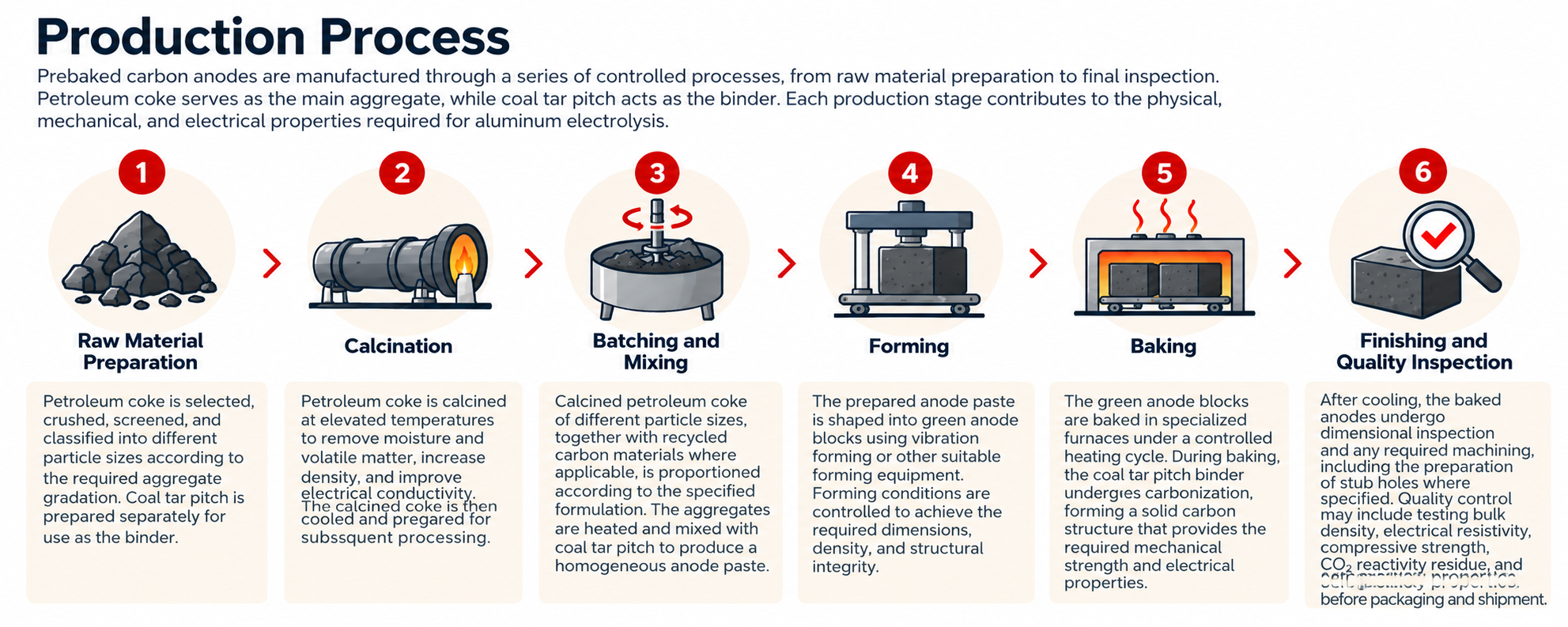
1. Raw Material Preparation
Petroleum coke is selected, crushed, screened, and classified into different particle sizes according to the required aggregate gradation. Coal tar pitch is prepared separately for use as the binder.
2. Calcination
Petroleum coke is calcined at elevated temperatures to remove moisture and volatile matter, increase density, and improve electrical conductivity. The calcined coke is then cooled and prepared for subsequent processing.
3. Batching and Mixing
Calcined petroleum coke of different particle sizes, together with recycled carbon materials where applicable, is proportioned according to the specified formulation. The aggregates are heated and mixed with coal tar pitch to produce a homogeneous anode paste.
4. Forming
The prepared anode paste is shaped into green anode blocks using vibration forming or other suitable forming equipment. Forming conditions are controlled to achieve the required dimensions, density, and structural integrity.
5. Baking
The green anode blocks are baked in specialized furnaces under a controlled heating cycle. During baking, the coal tar pitch binder undergoes carbonization, forming a solid carbon structure that provides the required mechanical strength and electrical properties.
6. Finishing and Quality Inspection
After cooling, the baked anodes undergo dimensional inspection and any required machining, including the preparation of stub holes where specified. Quality control may include testing bulk density, electrical resistivity, compressive strength, CO₂ reactivity residue, and other specified properties before packaging and shipment.
The manufacturing route, inspection items and acceptance criteria should be confirmed against the applicable product specification before supply.
